Thursday, 21 May 2015

Lost in France

Well, to be honest I was determined not to get lost in France so I was using a nice new shiny satnav with all my intended destinations already logged in. In fact it proved very handy especially in places like Dieppe and Rouen but more about that later.

My trip to northwest France was mainly to visit the grave of my mothers second uncle who died on the Somme on 8 May 1915 - exactly one hundred years ago. I also wanted to visit some significant First and Second World War sites.

I left Dover by DFDS ferry and arrived in Calais as planned. Switch on the new satnav! I headed west and drove to Cap Blanc Nez. This is a prominent chalk headland overlooking the channel towards the south coast of the England. A bit too hazy to see England while I was there...


The headland was occupied by the Germans during WW2 as a prime spot to monitor movements in the channel and to blast away at anything that moved on the sea or in the air. It's still dotted with the remains of bunkers and gun emplacements. 


In the months leading up to the D-Day, the allies had devised a vast and extremely complex deception plan called Operation Fortitude which convinced Hitler and his Generals that the invasion would happen near Calais. The essence of deception then and now is to build on what the enemy already thinks and, by dropping careful hints, convince him that his suspicions are right when all along you have other plans. Of course the 1944 invasion actually took place on the Normandy coast many miles to the south and even while it was underway in the early morning of 6 June, Hitler still thought that Calais was the intended target. Many of his Generals were so afraid of the man himself that they didn't want to inform him or argue with him until he convinced himself of the actual invasion location. In fact he remained asleep for the early stages of the landing and no one dared wake him - mad or what!

Just along the coast is Gris Nez used by the Germans for the same purpose.


You have to use your imagination a bit to see what it might have looked like with barbed wire, camouflage netting, guns, German solders etc but it must have looked pretty intimidating to the locals and anyone planning to attack from the sea.


Now it's used by a marine agency monitoring shipping in the channel. I think this still looks quite intimidating but I'm sure all this high security is done for good reason.


Incidentally, you would think that most French people would have visited these places many times before but it seemed that most of them had chosen to visit on the day I was there. Do they all have Friday afternoon off?

Further down the coast I visited the Todt Battery Museum at Audinghen. This is a massive reinforced concrete gun emplacement that would have contained a cannon capable of easily reaching the south coast on England. During its operation it was surrounded by newly planted trees to help hide it and a domestic house was painted on the side to deter allied bombing. I can't imagine the allies would have been taken in by that.


It still shows the scars of war...


Inside, as you walk around various tunnels and chambers towards the place where the cannon stood, there are many exhibits of uniforms, guns, tools, materials, etc giving a good impression of what life was like working there during the war.


The cannon was vast and weighed over 100 tons and obviously pointed out to sea. It's hard to get the scale of this but the green fence at the front is about 7 feet high.


Alongside the concrete gun emplacement is one of the remaining gun carriages that was moved on rails around the countryside.


While it has been well restored, it still shows the dents from incoming bullets and shells while it was in active service...


My first over-night stop was at Boulogne-Sur-Mer next to the large medieval castle, containing a well preserved keep (bottom right hand corner of the map) and a complete curtain wall with four gate houses. Within the walls lie the old town buildings including shops, houses, hotels, restaurants, the impressive cathedral and official buildings. My spot for the night was next to the castle keep (blue arrow).


 My view from the gallery window of Chateau Land Rover was  quite nice...


A walk across the old town took about 5 minutes and a complete circuit of the walls, 20 minutes. 

There was no explanation why the east gate wasn't just called 'The East Gate'. Perhaps it was taken from a scene in Up Pompeii. You can just imagine Lurcio saying, 'Oh no, don't titter Mrs, any port in a storm!'


Anyway, next morning I went into the museum in the old castle. It was well laid out, nicely presented and, as it was set within a fantastic building, it oozed historic character. The circular walls and the courtyard reminded me a bit of Colditz.


The museum is strung out on 3 floors and in the basement where its original Roman foundations can be seen.


From Boulogne, I traveled further down the coast to Dieppe intending to visit the museum that explains the ill-fated raid during the second world war. The Military Top-Brass and leading Politicians, including Churchill, never really explained the real purpose of the raid but it was thought to act as a dry run for the D-Day landings. While it proved to be a complete and costly failure, afterwards it was said that important lessons were learnt and ultimately saved many lives on D-Day. 

When I arrived in the town, I found much of the town centre cordoned off for a street fair and I couldn't get to where I wanted to go even with the satnavs help so I parked and walked around the fair.


Eventually, I managed to park in a square near the sea front and went for a walk around the rest of the town. The church on the hilltop must have been quite a landmark for the allied soldiers but I don't think many of them would have reached it.


Later, I settled down for the night. In the morning, I decided not to bother with the museum as, from the outside, it looked like it would be disappointing.

I drove to Rouen. With a bit of satnav-aided exploration, I found my way to the riverside where people were walking, rollerskating, jogging, biking or just sitting in the sun. This area had essentially been the town's riverside port on the banks of the Seine. All the warehouses and holding areas had been cleared away, leaving just a hint of its historic past including the old railway lines. Once the landscaping is complete, it will be a fantastic resource.


The city must have been severely bombed during the Second World War, like so many other places. As a result, much of the built up area is modern but the central link through the town centre contains many fascinating buildings ranging from the main cathedral...


...to beautiful 17th century buildings used as shops, restaurants and flats...

The town is famous as the place where Joan of Arc was tried and burnt at the stake. A striking modern building marks the location
(try to ignore the round-about!)...


I met my son Matt later in the afternoon and we went to St Sever cemetery to pay our respects to Francis Stephen Bloomfield.


We know he died on 8 May 1015 but, as his military records were lost at some point, we don't know the circumstances. We assume he was shot on the Western Front and transferred to a dressing station just behind the front where his wounds would have been treated - just like a triage in a modern A&E Department. It appears he was then moved further back to a hospital in Rouen to help his recovery. Rouen had many hospitals like this. Some soldiers would recover and be sent back to the the front, others, who were not fit for active service, would be sent home - a Blighty wound. Francis, it appears died in Rouen and was buried in the military extension to the civilian cemetery.

Matt and I have now visited the two Bloomfield brothers who were lost in France 100 years ago. 

After our time at the cemetery, we walked into the centre for a bite to eat and a good chat. The next morning, we parted company and I headed for the town of Albert, which was a British military base during WW1. 

The Somme 1916 Museum, in the basement of the main church, is a 'must see' place for any trip around the Somme.


It's important to understand what the residents and temporary visitors put up with during the war. The next photo gives a good impression...


The museum follows one of the main underground bunkers 10m below the church, and is very atmospheric. I won't spoil any visit you may make by adding photos of the interior, so just a shot of the main entrance...


The Lochnagar Crater lies about 3 miles up the road at the small village of La Boisselle. It was created by the Sappers mining under no-mans land and was blown up just a few minutes before the first day of the Somme battle - 1 July 1916.
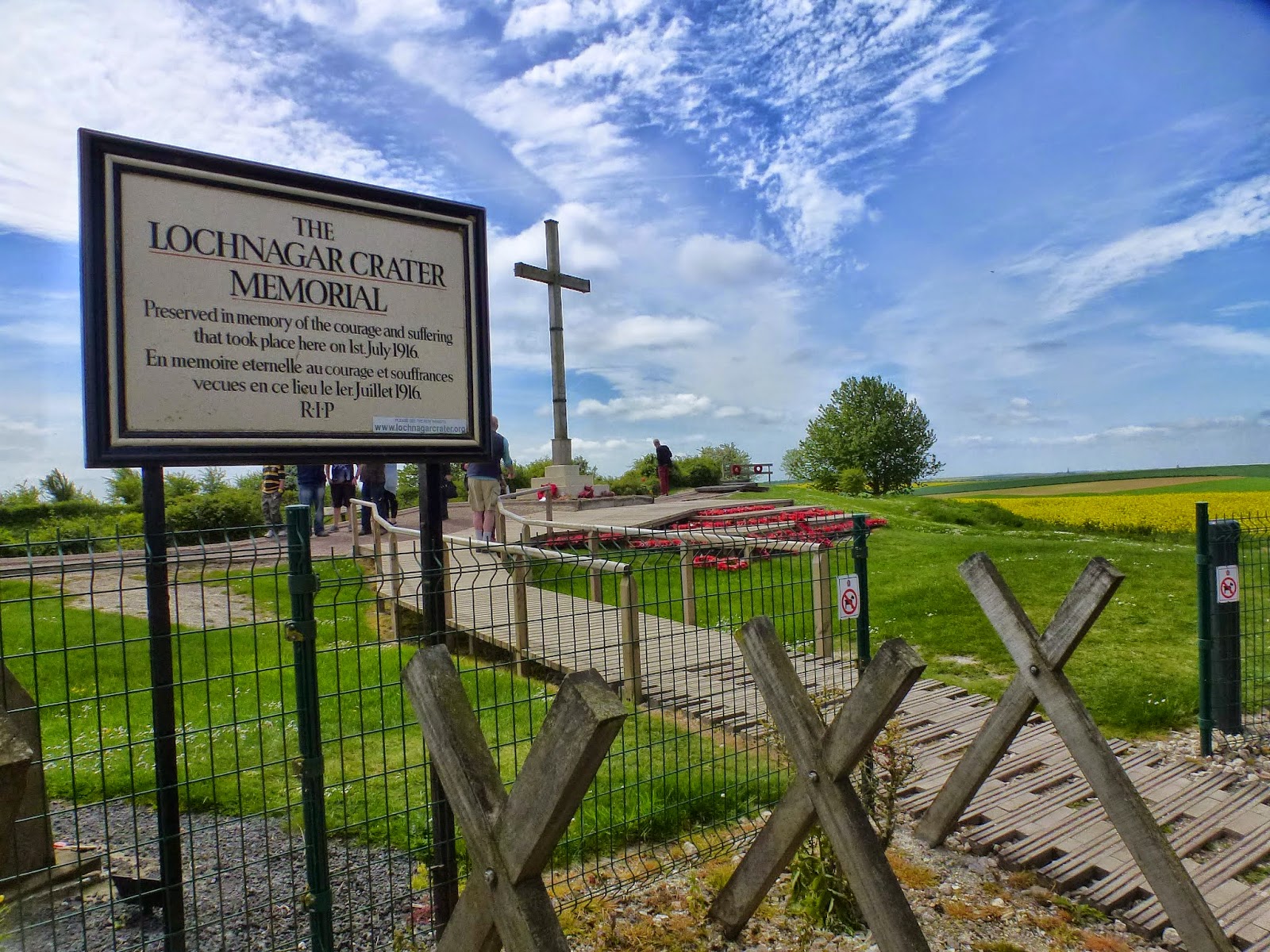


It, and many others like it, blasted great gaping holes in the German trenches.  Unfortunately, the week-long heavy artillery barrage and these explosions along the front line did not weaken the German positions enough and, when the smoke cleared, the German infantry, snipers and machine gunners resurfaced from their deep underground bunkers and wiped out most of the attacking Tommies. The statistics along the whole front are hard to comprehend with nearly 60,000 men lost just on the first day; 20,000 were killed. Of the 3 million men fighting at the front, 1.2 million were lost during the battle from July to November.

This crater, which is owned by an Englishman, now leaves a depression of 91 metres in diameter and 21 deep. It's scale can really only be appreciated from the air or actually walking around it. This photo shows about half of it!


I went on to visit a number of monuments and memorials to the east of Albert and there are many of them, after all this was at the centre of the fighting during the war, moving only short distances back and forth, with the loss of many thousands of lives.

My next significant stop was at Peronne, in the town held by the Germans for much of the war but then largely destroyed when they were forced to leave. The fine entrance towers and various walls nearby are now all that remains of the old castle; the rest of the building is new and houses a very good museum.


My next 'must see' memorial was at Mametz Wood, a vast woodland set within a rolling landscape that cost the allies thousands of lives to take from the Germans. While much of the wood was taken, the eastern section remained in German hands and they refused to leave.  Send for the Welsh!

Despite ferocious fighting in the face of well protected machine gun positions, the Welsh took the remaining part of the wood and a few years ago a new monument was erected to commemorate this remarkable achievement and terrible loss of life. The red Welsh Dragon stands in the position the Welsh found themselves in as they prepared to attack across a low, very open valley. It must have been terrifying. This location is quite remote and a bit off the beaten track but it well worth visiting. It's now a beautiful, peaceful place to reflect on the horror of this particular engagement and the war in general.


While there I bumped into Ian Truck-Shunter (not his real name), Barry and his wife (who went into the wood to look at various memorials), and Gary The *Big Canadian Lorry Driver (right). What a nice bunch of people! In fact they kept popping up all over the place during the rest of the day. It was great to meet them all.


* In fact, he was not that big, he just drives big Canadian lorries.

The next significant 'must see' sight is the vast memorial at Thiepval. At 45m high, it is the largest British memorial in the world with over 72,000 names engraved in the stone pillars


It is supported by a very good visitor centre, large car park and very attractive grounds.

Do you know, it's a small world. Not only did I bump into the Big Canadian Lorry Driver again but also someone from my home village in Suffolk. I was starting to think I was being followed!

The Newfoundland Memorial at Beaumont-Hamel commemorates the significant role played by the men of Newfoundland on the first day of the Somme and during the following months. This site, contains a good visitor centre, restored trench systems and cemeteries, extends to about 30 acres, and lies on the spot were the whole regiment was trapped while being pinned down by ferocious machine gun fire. After half an hour on the first day of the battle only 68 men remained. They suffered one of the highest casualty rates on the 1st July.

The regiments mascot, a Caribou, is reflected in this life-sized bronze statue. Quite striking!


On my way back to Calais, I stopped at Le Blockhaus, just off the A26. This site lies in a wooded glade and was one of the most significant WW2 sites where slave labourers built a vast reinforced concrete factory to build and launch the infamous V1 and V2 rockets. The scale of the place is breath-taking. It measures 33 high (just the part seen above ground), 75 m long and 40m wide. It took 90,000 tons of concrete to build.


For a long while the allies didn't know it existed and when they discovered it, they still couldn't work out what it was used for. However, they knew it had to be destroyed so a massive bombing raid was carried out on 27 August 1943 and it was put out of action. The scars of the bombing are plain to see. A number of bombs scored direct hits, like the one below, but it was a 'tall boy' bomb that finally put it out of action. It landed about 30m away, drilled itself into the ground and, when it exploded on a delay fuse, it sent an earthquake through the ground to shake the factory to its foundations. The factory was considered unsafe and closed.

It stands as a gruesome monument to one of the most evil wars in human history and to the people who build the structure and died there.
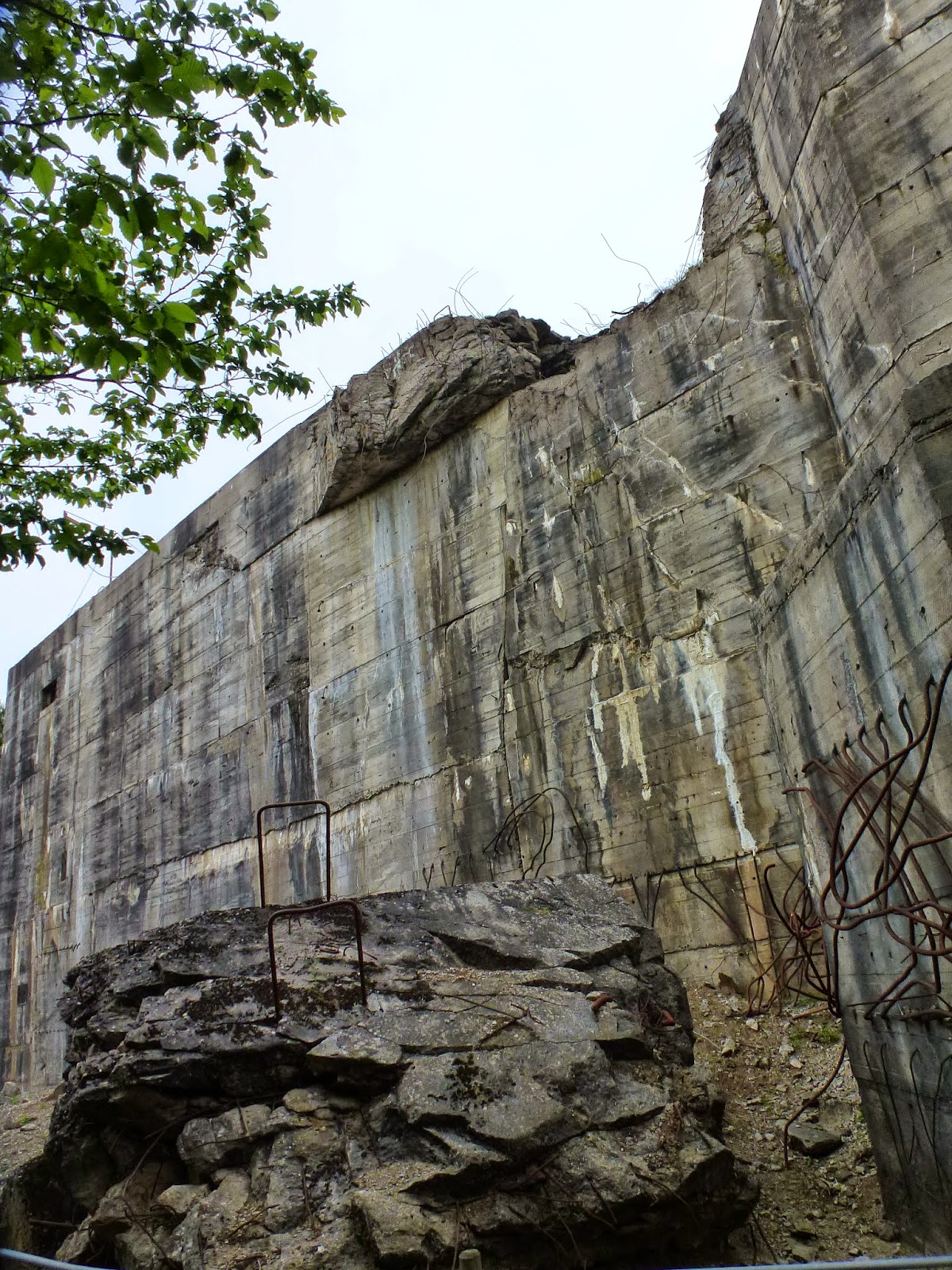


Photos cannot do it justice. I suggest you go and see it - its only a few miles from Calais.

Speaking of Calais, an odd site to visit lies in the heart of the town. This little museum is located in a German communications bunker in a modern park. It traces the history of the Second World War as seen by the people of Calais. 


It's comprehensive and quite interesting but is showing its age. The exhibits are largely original but are presented in an old fashioned almost 'DIY' style. When compared with modern museums and their 21st century interpretation and computers, it has a lot to live up to and struggles. I suggest you only visit it if you're waiting for your ferry on a wet Thursday afternoon.

Score: 4/10 could do better. Ouch...


So, back to the ferry and home. 

I'm pleased to say the trip lived up to my expectations. The sites were fantastic, all the people I met enhanced the trip and I learnt a lot more by seeing the places where history was made. I also got a much better understanding of what so many men went through.

Visiting the grave of Francis Stephen was important to both me and Matt. There is no one alive now who knew Stephen. I certainly didn't know him but it's important to pay respect when you can. 

They, and many thousands, may have been lost in France but they have not been forgotten.

Sunday, 3 May 2015

Diesel

'The Government has been ordered to act immediately to comply with European air pollution limits.
The decision by the Supreme Court relates to nitrogen dioxide, largely produced by diesel engines, and it could lead to tight controls on diesel vehicles in Britain's largest cities.'

It will be interesting to learn how the new government will control this, especially as it has not been mentioned by any of them during the run up to the election (even the Greens). 
I wonder if it will only apply, as the note above suggests, to Britain's largest cities?
I wonder if only new cars will be affected?
I wonder if red diesel will be exempt?
We'll have to wait and see but I guess drivers of private diesel cars will feel the main brunt of the measures but how far will the measures go? Negative measured may include increased cost of fuel, increased road tax, more stringent MOTs, etc. Positive measures may include cheaper petrol, cheaper petrol driven cars, lower road tax for them, etc.
But will this be extended to commercial vehicles like lorries, trains, taxis, coaches, boats and ships, farm vehicles, emergency vehicles, delivery and traders vans, etc, etc.
And, of course, where do narrowboats fit in?

Thursday, 30 April 2015

£1.99

Picture this: you walk into a Charity Shop and browse the book shelves. You pick out a book you want to buy and take it to the counter. The assistant looks at the sales ticket and sees it's been priced up as £1.99. 

You hand over 2 shiny pound coins and put the change, a single penny, in the charity tin on the counter. After all, it's a charity shop.

Then you wonder why they marked it up at £1.99. Do they really think you would only buy the book for £1.99 and not a nice round £2? Or do they think you might go next door and try to find the same book at a competitor's charity shop? Of course not!

So, Charity Shops, start treating us with a bit of common sense. We're not daft, we know £1.99 is only a penny short of £2 so why don't you save yourself a lot of printing, save yourselves time, save handling so much small change, and stop thinking you are in a real market place having to compete with other shops, 'cos you're not.

It would also save your staff  loads of time and aggravation having to listen to grumpy old men like me going on about ticket prices with 99p at the end of them!

Tuesday, 28 April 2015

NEPAL

If you can spare a few pounds, please help the people of Nepal.
Ring 0370 6060900 or go online to dec.org.uk


Sunday, 26 April 2015

Replacement lamp

Skylark was built with a very modern lamp for navigating at night and in tunnels. It reminds me of the lady behind the fish counter at my local Co-op, very clean and functional but lacking somewhat in the looks department. Fortunately, I have not had to take it out much (the lamp that is) but, when ever I do, I'm slightly embarrassed. You know the feeling, I'm sure.


So, when I happened across an older, more traditional looking lamp at my local car boot sale, I snapped it up. 


It looks like it was designed for an old car as it has a main and dipped beam. I think it would normally be fitted on top of a wing but as the lens was fitted upside down I guessed it was either fitted under a car bumper or maybe had already been used on a boat to illuminate the roof of tunnels - I will never know. As it's in such good condition I guessed the latter.

Anyway, attaching it to my short de-mountable metal post was a doddle but the electrical connections presented me a slight problem.


Instead of two simple terminals, one positive and one negative as on the other lamp, this lamp has three; one negative and two positives to operate the two different beams. As I only aim to use the main beam, I have to work out which of the three terminals to use. No great shakes, I hear you say, just need to whip out your multi-meter and practice a bit of basic electronics.

The next problem is finding a couple of spade connectors to fit the larger than average 8mm terminals. As yet I have not found anyone who makes them this size. I can get 4, 5, 6 and 9.5mm but not 8mm. Am I missing something? Yes, an 8mm connector! I will keep looking but guess I'll either use the 9.5mm ones and work on them with a pair of pliers, or cobble together a 'Heath Robinson' arrangement of twisted wires and insulation tape. If you have any suggestions, please email me. If not, I will persevere and hope for the best.

Update: Today, in my local car accessory shop, I found a crafty little connector made specifically for this situation, that is to attach an old style bulb to a modern electrical system. I can't remember what it's called but it has 3 female spade terminals of just the right size (8mm) linked to three wires, ready for connecting up. Now it's back to the boat to fit it and see if it works.


Saturday, 25 April 2015

Annual service

I carried out the annual service this week. Obviously, I check the oil, coolant and battery levels, tightness of bolts etc much more regularly and I pump grease into the stern tube at the end of each day's travel (including keeping things clean 'down below') but a full annual service is recommended by the manufacturers. I know some owners change their oil more frequently, especially if they do more hours, but for a strong diesel engine that gets used regularly and never gets much above 2000 revs, I think an annual service is plenty adequate. The cleanness of the oil that comes out of the engine proves this.

To clarify, the Owners Manual states:

Every year or 250 hours if sooner
• Change engine lubricating oil (standard sump)
• Change lubricating oil filter
• Check air cleaner element
• Spray the key switch with WD40 or equivalent to
lubricate the barrel.
• Check that all external nuts, bolts and fastenings are tight.
• Check ball joint nyloc nuts for tightness on both gearbox
and speed control levers.
Every 750 hours (In addition to 250 hours maintenance)
• Change air cleaner element.
• Change fuel filter.
• Change antifreeze.
• Change gearbox oil.
• Check electrical equipment, condition of hoses and belts,

replace as necessary.

By the way, I should mention, I am no expert on this so I rely heavily on others with much more knowledge and experience, and I make frequent referrals to the Owners Manual, which is very readable for a non-expert like me. Anyway, armed with old towels, basic tools and new oil/filters I set about the job. Incidentally, I find it much easier to sit on my 'make-do' wooden bench across the engine bay rather than leaning in. 


The in-built sump pump is a great bit of kit so I pump the old engine oil straight into old plastic milk bottles - they are free, handy sized and easy to dispose of. I mop up any oil drips as I go.The latex gloves also help to keep me and everything else clean. I've got no idea where I learnt to keep everything clean and tidy as I go, but it works.


Then it's out with the old filter (wrapped in a plastic bag) and in with the new one, re-fill, run up the engine again and check for leaks/level.  Adjust as needed. 

I then changed the fuel filter, checked the air filter (which didn't need changing this time), checked the transmission oil (which didn't need changing or topping up) and generally cleaned and tidied up the engine bay. Job done in about an hour.

While I was on board I re-painted some of the walls in the main cabin and galley, polished a few brass things, tidied up and mopped the floor. Everything looking shiny and new - fab.

Skylark is booked in to have her bottom blacked at the start of June, which is a good thing. I will then start to think about repainting her outside - a more major job that needs careful planning and preparation.

Now, I don't like to talk about politics but turning to my postal voting papers I have to decide who deserves to represent me and, to be honest, the choice is bleak. I am always torn between two opposed principles. I know democracy is a fine thing, it must be protected and we must not waste our vote but why oh why must we put up with candidates of a such a low caliber. Just finding people we can trust would help and if we could get someone who will actually do something useful to improve our lives that, it seems, would be a bonus. A voice in my head keeps telling me that voting for these drab people just encourages them to stand for election and we should do something positive to raise the bar like giving each of them an IQ test before they can stand or inject them all with a truth hormone or, better still, fine them a substantial sum for every failed promise. That would make them think twice before they opened their mouths. Oh well, perhaps one day...

Wednesday, 15 April 2015

Canoe seat webbing

I mentioned I'd broken the wicker seat on the canoe and had plans to refurbish it. Today I put those plans into action. You may be interested to see how I did it as it could be useful if you have to do the same or something similar.

Having taken the seat out of the canoe, I removed the old wicker 


and sanded down what would become the new underside.

I had already measured the seat very accurately and worked out I could get 7 nylon strips in one direction and 11 in the other, with a 1.5 mm gap between them. However, to be sure it would fit, I cut 7 short strips and laid them out along the shortest side. Btw, each strip measured 25 mm wide but this approach would also work with different widths.


Satisfied that they would all fit in I started fitting the webbing; starting at the outer edges first and moving inwards.

I have invested in a new stapler from B&Q and used this to attach the webbing, obviously working from the underside. For only £10 (less 10% Old Geezers discount), I'm really impressed with this piece of kit. It made the job so easy. In fact I can't think of anything else that would have done the job better.


Then, using the workbench adjustable stops to brace the seat against, I stretched the webbing over the opposite edge and stapled it again, to match the other side. Each time I cut the webbing, I melted the cut edge with a cigarette lighter to stop the ends fraying.


I completed the first run. I was pleased to see everything was straight and all the 1.5 mm gaps were equal.


I started on the longer side, interweaving the webbing as I went. This time I started in the middle and worked outwards to make sure it ended up symmetrical


I laid the short webbing strips along the edge again to make sure it all fitted before I started stapling.


Before I finished, I tapped each staple with a hammer to make sure they were all seated in properly.


After about an hour the seat was completed and I inspected my handwork...from underneath...


And from the topside...


I have to say, I was pretty chuffed with the result so I cracked open a bottle of Vimto in celebration.

Of course I could be accused of being biased so I took a second opinion from Lady Saga and she said it looked very professional. She liked the nice springy twang when she flicked it with her test finger (the one she uses to test for things like temperature, stickiness, sharpness, dustiness, etc etc.) 

All I have to do now is refit into the boat and give it a test flight.

.........................................................................................................

Update:

After re-fitting the seat, I took the canoe down the River Gipping to Claydon and slid it into the water. After the obligatory wobble as she found her way through the weeds at the edge of the river and I settled down, it turned out to be a very comfortable paddle. 

There was enough 'give' in the seat to make it feel like I was in contact with the boat without me sinking into the bilges and there was just enough 'adhesion' to stop me slipping around as I paddled. 

It is, of course, waterproof (which is a good thing under the circumstances) and there is a reasonable degree of breathability (if you get my drift). Also, as the nylon is rot-proof and tear-proof, it should last a long time. In fact, I don't think it can be bettered and, given the webbing had only cost me something in the region of £3.50, I think it will prove to be very good value for money. Job done!