In addition to my jaunts on Skylark, I have now joined the Suffolk Lowland Search and Rescue (SuLSar). It's exactly like Mountain Rescue but without the hills. So far, I have had basic training to be a Search Technician and have been called out a couple of times to search for missing persons (mispers - their term, not mine). It's ticking a number of boxes for me - it's interesting, enjoyable and, hopefully, useful. I'm also learning a lot of new stuff about navigation, communication, first aid, working with the emergency services, bike and river bank searches, etc etc. The men and women are from all walks of life and all of them have a similar sense of duty and humour to me. I hope my initial impression and enthusiasm lasts. If last weekend in Thetford Forest is anything to by, it should do...
By the way, the lady in the dark blue, sitting at the corner of the nissen hut, has a special place in my heart as I sat with her for about an hour in a crashed car, holding her head straight. She was a casualty in a multiple pile-up and my job was to protect her from further injury and keep her mind of her broken leg and possible broken back. I soon realised chatting to a complete stranger on the back seat of a crashed car, about your and her life, is a good way to get to know someone. When we said goodbye at the end of the exercise, we had a little hug - it seemed a bit daft at first but it was definitely the right thing to do. At least she survived the trauma of the accident and my droning on about life in Suffolk. Talking of new activities, I have also joined the Air Training Cadets as a Civilian Instructor. Once my application is finally approved by the RAF, which could take months I am told, I will be a fully fledged instructor to talk to the youngsters about trekking, woodland crafts, camping, navigation, etc. Despite the slowness of the admin, I have already started to the get involved. I have explained to the various organisers of these groups that I am fully committed to participate as needed but I also need to make time for my other activities such a boating, playing guitar and ukulele, walking, biking, holidays, AmDram, Land Rover and house maintenance, dog, chickens, etc etc. The list goes on... Who said you can slow down when you retire?
Just before her fourth birthday (28 April 2016), I booked Skylark in for her first Safety Inspection and she passed with flying colours. I shouldn't have been surprised but it was a bit of a relief. Incidentally, I was told by the Inspector that my Gas Regulator made by Clesse has been recalled. Apparently those made between June 2010 and Sept 2015 had an internal part that can rust and then fail. They will replace it foc. I just need to do the paperwork and photograph it. If you have one of these, you had better check it out on the Clesse website. I have just completed the annual service - including an oil change, filter change, checking the air filter, checking and tightening nuts, screws and fittings, cleaning everything, tidying the engine 'ole, etc.
I'm also now making a final decision on repainting the sides. I'm considering a light green by Craft Master called Bethnal Green. This should go well with the interior pant scheme and be more serviceable than the previous brand of ICI paint. Hopefully it won't fade so much either. Time will tell. The recommended coverage is 12 square metres to the litre (with no thinning) so, as the two cabin sides measure approximately 28 sq m and I will give it 2 undercoats and 2 top coats, that makes 112 sq m. That's just short of 10 cans of paint.The supplier is near by and carries this in stock so, if I run out, I will be able to restock quickly. The deck areas will be grey to match the roof which I did last year. So, full steam ahead. I just need to find a week of dry weather that's not too windy... or hot... or cold. Maybe Northern France?
I forgot to mention, I popped into Ypres on my way to Wizernes and stayed near the town centre with the view of attending the nightly playing of the Last Post at the Menin Gate. I got there too late on the first night and, on balance, didn't particularly want to be pushed around by the bus-loads of tourists on the second night, so I went on to St-Omer. Another time, maybe with Ben. However, I did have time to visit Kemmel and my mother's uncle Alfred, who died on 29 November 1914. His grave is just south of Ypres - see previous posts. That evening I popped up to the Canadian front line at Hill 62 near Sanctuary Wood and took in the sunset over Ypres in the distance. A good place to reflect...
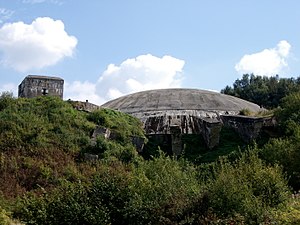
After Mons, I drove for the rest of the day to St-Omer and spent the night in the small town of Wizernes. The plan was to visit La Coupole the next day but unfortunately my mains inverter had packed up so I couldn't charge my camera battery - so no photos! Anyway, I did visit La Coupole and enjoyed every minute. It was basically a huge concrete bunker built into the hillside of a forest in 1943, designed to manufacture and launch V2 rockets on London. Thousands of German, French and slave workers built the complex including a vast concrete dome and miles of underground tunnels. This was like something out of a science fiction film but frighteningly real. The allies knew it was there but didn't know what it was for. However, because of its size and location, they knew it must be destroyed. It was therefore bombed and finally destroyed by the Tall Boy bomb that undermined its foundations. The dome is fully accessible with fascinating exhibits and the visitor centre includes a 3-D film; all very interesting, especially the post war stories of how the Americans 'encouraged' the top German rocket scientists to go over to the US to help build their space rockets in advance of the Russians. Again, it was all a bit 'James Bond' but true. This is a 'must see' place. For the background see http://www.lacoupole-france.co.uk/
After Waterloo, I headed down to Mons, the location of the first British engagement in late August 1914. It was here that the 4th Fusiliers of the British Expeditionary Force had to hold the Germans along theMons-Condé Canal. While the Germans were initially taken by surprise following the high rate of accurate fire of the British Lee Enfield rifle and the Lewis Machine gun, after about 6 hours of fighting, the British commanders ordered a withdrawal due to the overwhelming numbers of Germans. It was on this canal that the first Victoria Cross of the war was posthumously awarded to Lieutenant Maurice Dease. He is buried in the very tranquil Mons Military Cemetery to the east of the town alongside many of his comrades and Germans who were also killed at the time. After 100 years it's poignant to see the graves of both British and German soldiers lying together. You should read about this battle and, in particular about Dease and his mates - what brave young men... You should see BBC iPlayer > Channel 3 > Our World War > The First Day. It is a stunning recreation of the first day at Mons. This is available to see for 3 months from now. The other two programmes in the box set are good too.
The recently refurbished Mons Museum on the edge of the town centre has certainly had a good deal of money spent on it but I was a little disappointed. The interior is very dark and the English text on the exhibits is very small. I guess this is done to add atmosphere to the place but much of the information is hard to read and therefore the meaning is lost. Never mind, I could still look at the pictures.
OK, this is something we all learn about at school, but until you've been there, I don't think you can have any idea what was involved. The main battle was fought on 18 June 1815 and we all know that the Duke of Wellington's army beat Napolian's, but did you know:
The battle was waged three miles south of the town of Waterloo in the villages of Braine-l’Alleud and Plancenoit along the Mont Saint Jean Ridge. While the French referred to the military clash as the “Battle of Mont Saint-Jean,” it became known in most of the world as the “Battle of Waterloo” because the Duke of Wellington, who led the victorious forces, made his headquarters in the village of Waterloo. Napoleon never set a foot in Waterloo.
This was the coaching house Wellington stayed in the night before the battle. It's now a museum and has many interesting artifacts inside though it's not very big and when I was there the builders were in doing some restoration work.
Napolian stayed at a farm house about 8 km to the south. It is also a museum and is even smaller than Wellington's museum but still worth seeing if you want to get an overall view of the battle.
The most impressive museum is the new underground one at the Lion's Mound to the south of Waterloo, where the actual battle took place. The mound was built a few years after the battle and is well worth walk up to see the surrounding landscape.
The round building is the Panorama and contains a 360 degree painting of the battle field. Very impressive...
The main museum, as I said is underground and is vast, containing more than you can hope to take in. So, give it a go but get there early to avoid the bus loads of tourists and try to work out how to use the audio tape before you start!
Did you know heavy rain fell upon the region around Waterloo on the night before the battle. Napoleon’s artillery was among his greatest strengths, but the French emperor feared that the soggy and muddy conditions would bog down the advance of his men, horses and heavy guns. Hoping that the ground would dry, Napoleon waited until midday to launch his attack. The delay would prove costly as it ultimately allowed Blucher’s Prussian army to join the fight before the French could defeat Wellington’s forces.
You probably know, the Duke of Wellington was British, but the army he led into battle was a multi-national force. British troops represented only one-third of Wellington’s army, and the majority of those soldiers were Irish, Welsh and Scottish. (Wellington himself was born in Ireland and of Anglo-Irish ancestry.) Approximately half of Wellington’s forces hailed from German states, and Dutch and Belgian soldiers fought in sizable numbers as well. In addition to Wellington’s army, more than 50,000 Prussians under Marshal Blucher arrived at the battlefield in the late afternoon and turned the tide of the fight.
Following the Battle of Waterloo, Napoleon returned to Paris, where he was forced to abdicate on June 22, 1815. He fled to the coastal city of Rochefort, from where he likely intended to sail to the United States, which had just concluded its own war with Great Britain. “You must have heard of the new misfortune of the emperor,” wrote one of Napoleon’s relatives to another in the wake of his abdication. “He’s going to the United States, where we shall all join him.” British ships, however, had blockaded Rochefort, and the former emperor did not want to risk the potential embarrassment of being caught hiding on board a vessel. With his passage to the United States blocked, Napoleon surrendered to a British warship on July 15, 1815, and three months later he was exiled to the remote South Atlantic island of St. Helena, where he lived out his final six years until his death in 1821. Napoleon’s brother Joseph, the deposed king of Spain, was able to make safe passage to the United States from another French port and lived in New Jersey for 15 years. Fleeing Bonapartists also established the short-lived Vine and Olive Colony in Alabama as a safe haven.
Within hours of the battle’s end, locals employing pliers as well as small hammers and chisels began to remove the front teeth from tens of thousands of soldiers lying dead on the battlefield. With demand for human teeth high, the looters sold the pilfered teeth to dethem into dentures. According to England’s National Army Museum, English dentists did nothing to conceal their sources, advertising the dentures as “Waterloo teeth” or “Waterloo ivory.” Even by the time of the Civil War, English dentists continued to do a brisk trade importing the teeth of fallen soldiers, still referred to as “Waterloo teeth.”Napoleon Bonaparhe peace treaty agreed to between France and the European powers in November 1815 reduced the size of French territory and required the defeated country to pay an enormous indemnity over the course of five years. In recognition of his servic,eParliament awarded the Duke of Wellington 200,000 British pounds, equivalent to 15 million British pounds today, according to the Royal Engineers Museum.
Dinant has a small but dominant citadel perched high above the town. This is well worth a visit as it's got quite and interesting history especially during the first few months of the First World War when German troops attacked the town and killed hundreds of civilians.
I parked at the top, walked around the museum then took the steps down to the town. There is a cable car (it's just by the trees at the top). The walk back up the hill was good exercise but I constantly thought how well defended this side of the citadel was - I would not have wanted to make that approach if there were people chucking stuff down at me!
Namur also has a citadel but it is much larger than Dinant. I only stopped her for a lunch and coffee break so didn't spend much time exploring. Maybe this is something for another trip.